Workplace analytics that respects your people.
Dazr Analytics shows how teams work: how fast they answer customers, where the hours go, how much of the week is meetings. It does that with counts and durations only, team totals by default and never a number for a group of fewer than 5 people.
Part of Dazr Enterprise. Encrypted and stored in the EU, by an Italian company.
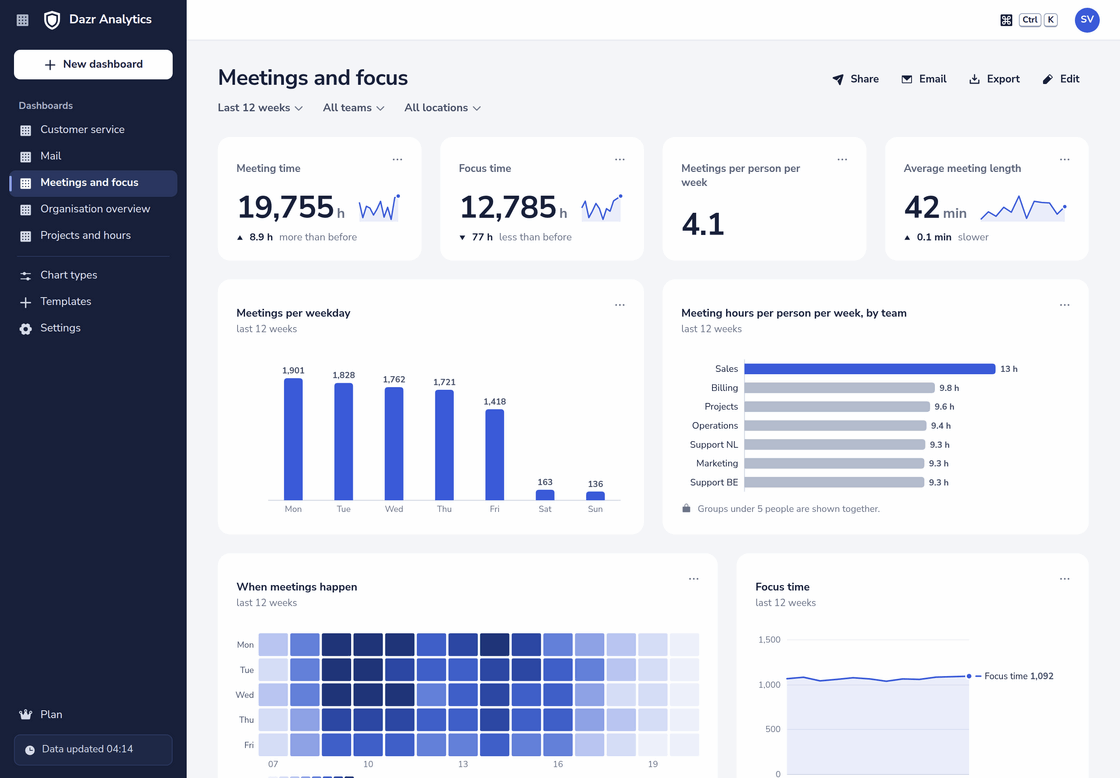
Meetings and focus, per team: meeting hours per person per week, and when meetings happen. No meeting title, no names, and small teams shown together.
What Analytics keeps.
How many and how long. The content of the work stays in the app it belongs to.
Every number is a count, a duration, a level or a share: tickets solved, minutes to a first reply, hours logged, storage used. Analytics keeps them per day and per team.
No message text, no subject, no meeting title or place, no note, no file name and no document. They are not read into Analytics at all.
Mail is counted in the shared inboxes only, never in personal mailboxes. In Teams, only the organisation’s channels count; direct chats and group chats never do.
A meeting counts when at least one other person is in it: when, how long and whether someone from outside joins. What it is about stays in the calendar.
The daily numbers are deleted by themselves after 25 months. Dashboards keep only their settings, not a copy of the data.
Everything Analytics keeps is stored encrypted on European infrastructure, like the rest of Dazr, under European law.
The 5-person rule, plainly.
A total of 4 people is almost a person. So Analytics never shows one.
Split a number by team, location or role, and every group of fewer than 5 people is added to the other small groups as one bar. If even those add up to fewer than 5, they are left out.
Choose a team of 3 in the filter bar, and the charts stay empty with a note that says why. The team is still in the list, so nobody wonders where it went.
Subtracting one total from another can reveal a small group: all people, minus all people outside the HR team of 3, is that team. Analytics checks for this and hides the answer when it would.
Teams and locations, set up once
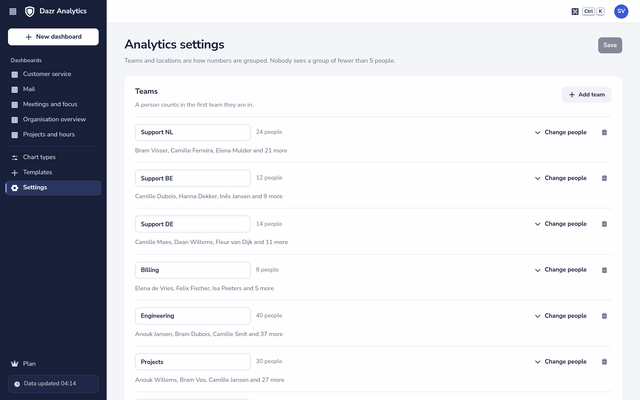
Owners and admins decide how people are grouped: the teams and the office or country of each person. A person counts in the first team they are in. The settings say it at the top: nobody sees a group of fewer than 5 people.
Until teams are set up, Analytics shows the organisation as a whole.
Who sees what.
Checked on our server for every chart, not only hidden in the screen.
| Who | What they see |
|---|---|
| Owners and admins | Every metric, and per person for hours logged, Desk agents and security. They also set up teams, locations and who may view. |
| Read-only admins | The same numbers as owners and admins, without changing any settings |
| Analytics viewers | Team totals of every app except security, never per person. Owners and admins give this permission to the colleagues who need it. |
| A colleague you share a dashboard with | Only that dashboard, and in it only what a viewer may see. A chart with more says so instead of showing numbers. |
| Recipients of a scheduled email | The headline numbers they are allowed to see, each in their own email |
| Everyone else | Nothing. Analytics does not open for them. |
Owners and admins do not see other people’s dashboards unless they are shared with them.
The three places with a person in them.
Some questions are about one person by nature. Analytics keeps them to three, and says which.
Time people log themselves in Dazr Time, for planning and invoicing. Per person, the same hours a project lead already sees in the timesheets.
Tickets solved, reply times and ratings per agent, to spread the work in a helpdesk.
Sign-ins, blocked attempts and accounts without a sign-in for 30 days, to find an account at risk.
Meetings, focus time, mail, chat, files and documents have no person in them at all, for anyone.
What it is not.
Some tools that measure work go much further. Dazr Analytics does none of this.
There is no productivity score, no ranking of people and no measure of how busy someone looks.
Analytics never records what people type, which apps they open or what is on their screen.
A location is the office or country an admin assigns to a person in the settings, not where their device is.
Made with the GDPR in mind.
Data minimisation is a principle of the GDPR. Analytics is built around it, and leaves the decisions to you.
Your organisation decides what it uses Analytics for, and who may open it. Dazr processes the numbers for you, under the data processing agreement included in every company plan.
Explain what you measure and why, before you start. This page and the note under every dashboard help: team totals, groups under 5 people hidden, per person only in three places.
In many countries a works council has a say in tools that can measure work. Show them the settings and the list of metrics, and choose the viewers together.
More about how Dazr handles data in the trust centre and the privacy notice.
Questions, answered.
Can my manager see my meetings?
No. Meeting and focus numbers in Analytics are totals per team or location, never per person, and never with a title, a place or the people in a meeting.
Can Analytics read our mail or chats?
No. It counts mail in the organisation’s shared inboxes and messages in its channels, with their times. Personal mailboxes, direct chats and group chats are never counted, and no text is read.
Is Dazr Analytics GDPR compliant?
Compliance depends on how an organisation uses a tool, so no tool can promise it alone. Dazr Analytics keeps as little as it can, stores it encrypted in the EU, deletes it after 25 months and comes with a data processing agreement.
Why 5 people?
Below 5, a total says too much about each person in it. Five is a common threshold for reporting about groups of people, and Analytics applies it everywhere, also when you filter or subtract.
Numbers about teams, not people.
Dazr Analytics is part of Dazr Enterprise.
Dazr AnalyticsCustomer service dashboardTeam hours and project reportsQuestions? Contact us